10 Best CRM Software for Small Businesses in 2026
Choosing the right Customer Relationship Management (CRM) software is one of the most consequential decisions a small business owner can make. The landscape has evolved rapidly by 2026; what used to be a glorified digital address book is now a central hub powered by artificial intelligence and automated workflows. Modern small business CRMs can manage marketing, track sales pipelines, and handle customer support all from a single window.
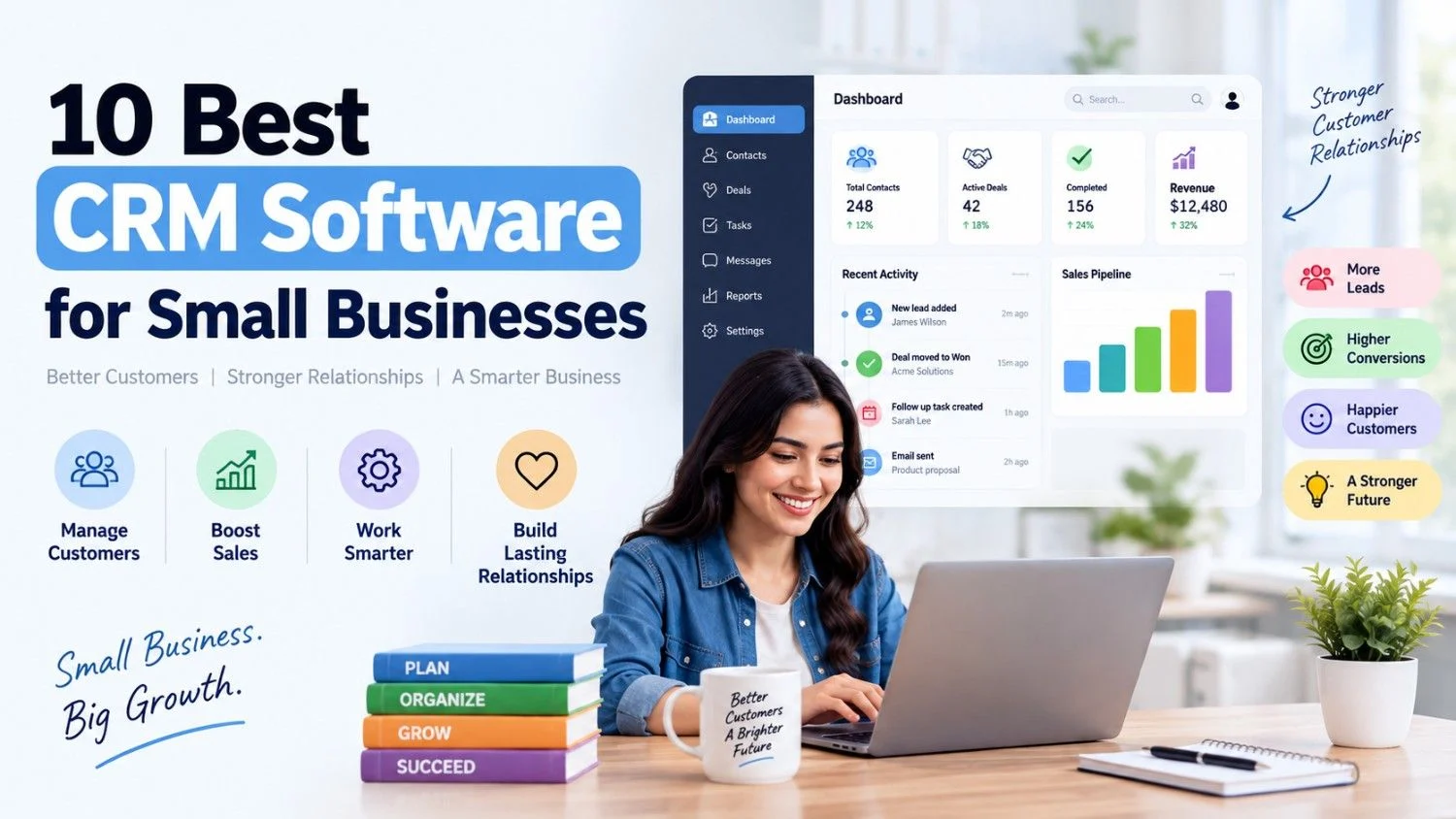
Notice in the typical CRM dashboard below how data is consolidated. Instead of toggling between spreadsheets, a modern CRM gives you an immediate bird’s-eye view of your win rates, average days to close a deal, and the total value of your sales pipeline. This level of visibility is exactly what transforms a chaotic sales process into a predictable revenue machine.
Before we dive into the deep reviews of our top 10 picks, it helps to understand exactly what you need. A heavy-hitting marketing team has vastly different requirements than a small, phone-based outbound sales team. Use the interactive tool below to adjust your team size and primary goals to see which CRM ecosystem might fit your budget and workflow best.
Key insight: You will often find that the cheapest CRM at 2 users becomes significantly more expensive than its competitors when you scale up to 10 users and require advanced automation. Always project your costs based on where your team will be in two years, not just today.
Here are our extensive reviews of the top 10 CRM software platforms for small businesses in 2026.
1. HubSpot CRM
Best for: Scaling businesses that want marketing and sales in one place.
Website: hubspot.com
HubSpot remains one of the most recognizable names in the CRM space, and for good reason. Its platform is incredibly intuitive, meaning your team will actually want to use it. In 2026, HubSpot’s Free CRM remains a legitimate starting point, offering contact management, deal tracking, and basic email tools for up to 2 users and 1,000 contacts.
When you outgrow the free tier, the Starter plan kicks in to remove HubSpot branding and add deeper automation. HubSpot truly shines when you connect its Sales Hub with its Marketing Hub, allowing small businesses to track a customer from their first blog visit all the way to a closed deal.
-
2026 Pricing: Free for up to 2 users. The Starter plan begins at $7 per seat/month (billed annually).
-
Key Features: Visual sales pipeline, meeting scheduler, website live chat, and comprehensive email tracking.
-
Pros: Exceptionally easy to use, highly scalable, and features a vast integration marketplace.
-
Cons: The price jump from Starter to Professional ($90/seat) is incredibly steep for small businesses.
2. Zoho CRM
Best for: Unbeatable value and all-in-one business management.
Website: zoho.com/crm
If you want enterprise-grade features on a small business budget, Zoho CRM is arguably the strongest price-to-feature platform on the market. Unlike competitors that gate their best features behind premium tiers, Zoho includes robust workflow rules and its AI assistant (Zia) starting right at the Standard tier.
Zoho is particularly powerful if you adopt the rest of the Zoho ecosystem (like Zoho Books for accounting or Zoho Desk for support). It handles everything from lead capture to invoicing without forcing you to buy third-party plugins.
-
2026 Pricing: Free tier for up to 3 users. Standard plans start at $14 per user/month (billed annually).
-
Key Features: Zia AI predictions, omnichannel communication, advanced workflow automation, and deep analytics.
-
Pros: Incredible value for money, deep customization, and seamless integration with 40+ other Zoho apps.
-
Cons: The interface can feel a bit cluttered, and there is a steeper learning curve compared to HubSpot.
3. Pipedrive
Best for: Pure sales teams focused on visual pipeline management.
Website: pipedrive.com
Pipedrive was built by salespeople, for salespeople. It strips away the complex, bloated features of traditional CRMs and focuses entirely on moving deals through a visual pipeline. Pipedrive is the fastest platform on this list to onboard a sales team onto; if your staff knows how to drag and drop a card on a screen, they know how to use Pipedrive.
In 2026, Pipedrive continues to excel with its activity-based selling methodology, prompting your reps to take the next logical step to close a deal rather than just staring at static data.
-
2026 Pricing: Lite plan starts at $14 per seat/month (billed annually). No free tier, but offers a 14-day trial.
-
Key Features: Highly visual drag-and-drop pipeline, customizable stages, email synchronization, and activity reminders.
-
Pros: The cleanest pipeline UI on the market, very easy to learn, and keeps sales reps highly focused.
-
Cons: Not ideal if you need deep marketing tools; AI features and deep automation are gated behind the Premium ($49/seat) tier.
4. Freshsales (by Freshworks)
Best for: Startups wanting quick setup and built-in AI.
Website: freshworks.com/crm/sales
Freshsales is an Editors’ Choice winner for its intuitive user experience and flexibility. It is designed specifically to prevent CRM tasks from becoming overwhelming for beginners. One of its standout features in 2026 is “Freddy AI,” an assistant that analyzes contact profiles, scores leads, and suggests the next best action to close deals.
Freshsales also includes built-in phone and email capabilities, meaning your team doesn’t have to leave the CRM dashboard to make a call or send a targeted campaign.
-
2026 Pricing: Free for up to 3 users. Growth tier starts at a highly affordable $9 per user/month.
-
Key Features: Freddy AI lead scoring, built-in dialer, visual deal pipelines, and automated chat tools.
-
Pros: Very affordable starting costs, fast onboarding, and excellent email inbox management tools.
-
Cons: The base tier is somewhat limited, supporting just one sales pipeline.
5. monday CRM
Best for: Teams looking to blend project management with sales.
Website: monday.com/crm
If your small business operates on a highly collaborative, project-based model, monday CRM is a phenomenal choice. Built on top of the popular monday.com Work OS, this CRM functions more like a flexible, highly visual spreadsheet on steroids. It is perfect for teams that need to manage a client relationship after the sale is closed just as closely as they manage the initial pitch.
-
2026 Pricing: Limited 2-seat free tier. Basic plans start at $12 per user/month (with a 3-seat minimum requirement).
-
Key Features: Color-coded board views, custom automations, post-sale project tracking, and timeline mapping.
-
Pros: Beautiful and friendly user design, excellent for non-traditional sales workflows, and integrates seamlessly with other monday.com tools.
-
Cons: The 3-seat minimum forces solo founders to pay for unused licenses.
6. Apptivo
Best for: Highly customizable, end-to-end workflows.
Website: apptivo.com
Apptivo earns high marks in 2026 for its modular, app-based architecture. Rather than giving you a rigid system, Apptivo allows you to select specific “apps” (like Lead Management, Invoicing, or Help Desk) and combine them to create a tailor-made CRM environment. This makes it an incredibly strong choice for small businesses that need a CRM capable of handling everything from initial lead capture to sending the final invoice.
-
2026 Pricing: Plans generally start around $10 per user/month, making it very budget-friendly.
-
Key Features: Modular app structure, detailed lead profiles, robust deal creation tools, and integrated invoicing.
-
Pros: Superb flexibility, extensively customizable dashboards, and great end-to-end operational capabilities.
-
Cons: The interface can feel a bit dated compared to modern competitors like Monday or Pipedrive.
7. Salesforce Starter Suite
Best for: Ambitious small businesses planning for massive scale.
Website: salesforce.com/starter
Salesforce is the undisputed titan of the enterprise CRM world, but their traditional software is notoriously complex and expensive for small businesses. Enter the Salesforce Starter Suite in 2026. This streamlined version offers best-in-class sales tools, a robust commerce hub, and a surprisingly easy-to-use interface with minimal setup required.
If your small business has aggressive growth goals and you know you will eventually need enterprise-level architecture, starting in the Salesforce ecosystem saves you the headache of migrating data later.
-
2026 Pricing: $25 per user/month. No free tier, but offers a 30-day trial.
-
Key Features: Premium sales dashboards, integrated marketing templates, commerce tools, and world-class data security.
-
Pros: Unmatched scalability, powerful built-in best practices, and you won’t ever “outgrow” the software.
-
Cons: Setup is still more intensive than alternatives, and upgrading to the Pro Suite jumps to $100/user.
8. Bigin by Zoho CRM
Best for: Micro-businesses and strict budgets.
Website: bigin.com
Designed specifically for small and micro-businesses that find full-fledged CRMs intimidating, Bigin is Zoho’s “smaller sibling.” It strips away the complex enterprise features and focuses purely on what a growing business needs: simple pipelines, contact management, and basic VoIP capabilities. Earning high praise for affordability, Bigin ensures you don’t break the bank while transitioning away from spreadsheets.
-
2026 Pricing: Ranges from free to a maximum of $21 per user/month for the most comprehensive plan.
-
Key Features: Multiple pipelines, built-in telephony, payment collection support, and clean mobile apps.
-
Pros: Extremely affordable, virtually no learning curve, and easy migration to Zoho CRM later.
-
Cons: Lacks advanced AI features and deeper automation capabilities.
9. Capsule CRM
Best for: Absolute simplicity and ease of use.
Website: capsulecrm.com
Capsule CRM focuses on doing the basics exceptionally well without cluttering the screen. It is designed to be as frictionless as possible, allowing small business owners to quickly log calls, manage tasks, and track their pipeline. It’s a favorite for businesses that just need to get organized quickly without committing to a massive software rollout.
-
2026 Pricing: Free tier for up to 2 users and 250 contacts. The Starter plan is $21 per month.
-
Key Features: Simple sales pipelines, calendar integrations, task management, and mobile accessibility.
-
Pros: Very easy to learn, clean UI, and a generous free tier for micro-businesses.
-
Cons: True workflow automation is locked behind the Growth tier ($38/seat), which is pricey for what you get.
10. Close
Best for: High-volume outbound calling and sales teams.
Website: close.com
Close is a powerhouse for small businesses that rely heavily on cold calling, SMS outreach, and rapid email follow-ups. Unlike traditional CRMs where the phone dialer is an afterthought or an expensive add-on, Close puts communication front and center. It is designed to minimize the number of clicks a rep needs to make to dial a prospect and log a call.
-
2026 Pricing: $9–$19 for a Solo user (1 user maximum on this tier). Team plans scale up from there.
-
Key Features: Built-in predictive dialer, SMS marketing, email sequencing, and call recording.
-
Pros: Incredible for outbound sales velocity; keeps reps highly productive.
-
Cons: Both automation and extra call minutes cost extra; no free tier available.
How to Choose the Right Small Business CRM in 2026
When evaluating these tools, look past the marketing copy and focus on these three factors:
-
Project Your True Costs: Don’t just look at the base price. Look at what it will cost when you hit 10 employees and need to add automation. Platforms like HubSpot have a steep curve, while Zoho and Apptivo remain relatively flat as you scale.
-
Evaluate Your Sales Motion: Do you sell primarily through marketing content and inbound leads? You need HubSpot or ActiveCampaign. Do you sell by dialing 100 phone numbers a day? You need Close or Freshsales.
-
Check the Integrations: A CRM is only as good as the software it talks to. Ensure your choice integrates natively with your existing accounting software (like QuickBooks or Xero), your calendar, and your email client.
Conclusion
Upgrading from spreadsheets to a dedicated CRM is one of the most profitable moves a small business can make. For the perfect balance of price and performance in 2026, Zoho CRM and Freshsales are incredibly tough to beat for general use. If you prioritize an elegant, zero-friction interface for a pure sales team, Pipedrive is the clear winner. Take advantage of the free trials, import a small batch of your contacts, and see which platform naturally fits your team’s daily rhythm.